

Personal Branding for Experts on LinkedIn: How to Turn Expertise Into Leads (Not Just Content)
A practical guide for experts who want to become known, trusted, and easier to buy from
Last updated: May 2026
Quick Answer
A lead-generating personal brand helps experts become known for a specific problem, trusted for their thinking, and easier to buy from. On LinkedIn, this means turning deep expertise into clear positioning, authority content, visible proof, and conversations that lead to enquiries.
In the age of AI search, it also means creating content that answer engines can understand, trust, and associate with your expertise. The opportunity is that small expert accounts can become visible and cited when their content is clear, structured, authentic, and consistently connected to a specific problem.
If you are an expert, consultant, coach, founder, or specialist service provider, your personal brand should not exist to make you popular.
It should help the right people understand what you do, remember what you solve, trust how you think, and feel confident taking the next step with you.
That is what I mean by a lead-generating personal brand.
It is not about posting every day. It is not about becoming an influencer. It is not about turning your life into content.
It is about becoming known for the right thing by the right people.
Lead-Generating Personal Brand Definition
A lead-generating personal brand is a trust-building system that turns your expertise into visibility, authority, and enquiries.
It makes three things clear:
Who you help
What problem you solve
Why your way of thinking is worth trusting
When those three things are clear and repeated consistently, people start to associate you with a specific problem, outcome, or transformation.
That association is what creates commercial value.
Because when someone in your network hears, “I need help with this,” your name becomes easier to remember, recommend, and refer.
What a lead-generating personal brand is not
A lead-generating personal brand is not:
Posting motivational quotes
Sharing random tips
Chasing viral content
Copying influencer formats
Turning every post into a sales pitch
Talking about yourself constantly
Trying to appeal to everyone
Those things might create attention, but attention alone does not create trust.
And trust is what turns visibility into enquiries.
Why Deep Expertise Does Not Automatically Create Leads on LinkedIn
Many experts assume that being good should be enough.
They have years of experience. They get strong results for clients. They can explain complex things clearly in calls, workshops, proposals, and meetings.
But online, that expertise often stays hidden.
Not because the expert has nothing valuable to say.
But because their expertise has not been translated into a clear message that their audience can understand, remember, and repeat.
This is why so many brilliant people become “best-kept secrets.”
They are trusted by the people who already know them, but they are not visible or memorable enough to be discovered by the people who need them next.
Why LinkedIn Matters for Expert-Led Personal Brands
LinkedIn matters because it is where many professional buyers already research, compare, and validate people before they enquire.
For experts, consultants, coaches, founders, and specialist service providers, LinkedIn is not just a place to post updates. It is a search, trust, and demand-building environment.
LinkedIn reports that B2B organizations using LinkedIn Live with paid promotion have seen 131 percent higher click-through rates, 19 percent higher post-event engagement rates, and a 1.5x higher likelihood of attendees engaging with future company marketing: https://www.linkedin.com/business/marketing/blog/events/b2b-live-event-streaming
The same LinkedIn article states that LinkedIn Live videos get an average of 7x more reactions and 24x more comments than native videos from the same broadcasters: https://www.linkedin.com/business/marketing/blog/events/b2b-live-event-streaming
For a personal brand, the lesson is simple.
People do not only want polished posts.
They want to see how you think, hear your voice, understand your point of view, and experience your expertise before they buy.
That is why LinkedIn content should not only aim for reach.
It should build recognition, trust, and buyer confidence.
How AI Tools Help Experts Become BEST KNOWN
AI tools matter because they now influence both sides of expert visibility.
On one side, AI tools can help experts create more clarity.
They can help you extract ideas from client calls, organise your thinking, identify repeated themes, shape content pillars, turn complex expertise into plain English, and build a consistent LinkedIn content system.
Used well, AI does not replace your voice.
It helps reveal it.
The goal is not to sound like AI.
The goal is to use AI to make your real expertise easier to structure, explain, and share.
On the other side, AI tools are becoming discovery engines.
People are asking ChatGPT, Perplexity, Claude, Copilot, Google AI Overviews, and LinkedIn’s own AI-powered systems questions such as:
Who is the best expert for this problem?
What should I know before hiring a consultant?
How do I build a personal brand on LinkedIn?
Who helps experts turn their knowledge into leads?
What does a strong LinkedIn content strategy look like?
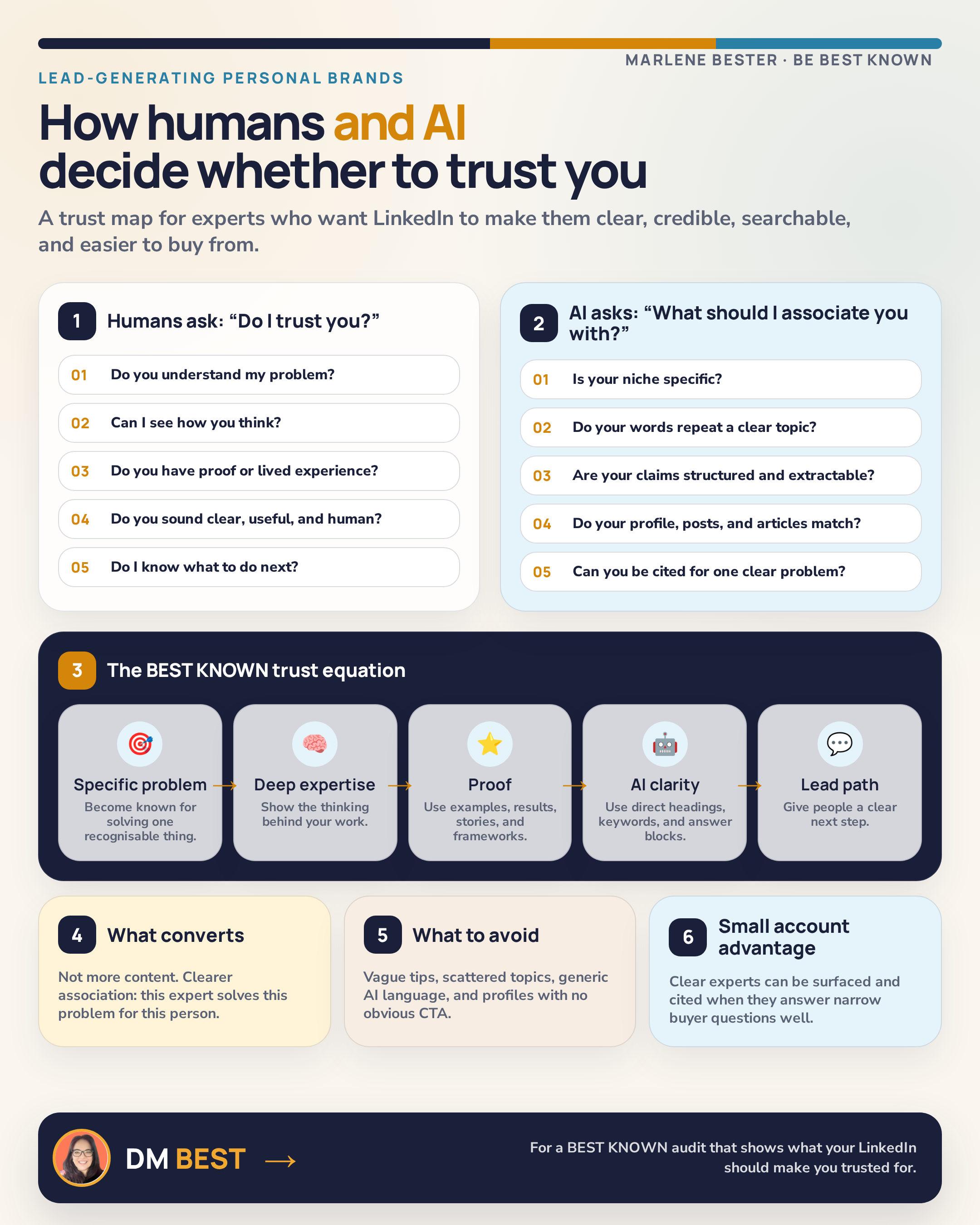
If your content is vague, inconsistent, or too generic, AI systems have very little to associate you with.
If your content is clear, structured, specific, and repeated across your profile, posts, articles, and website, you give both people and AI systems stronger signals about what you should be known for.
This is why search changing creates opportunity.
You do not need to be the biggest account in your industry to become visible.
You need to be clear enough, specific enough, and useful enough to be understood, remembered, and cited.
The real job of personal branding
The job of personal branding is not to make you famous.
The job is to make you known for something specific.
For example:
Not just “leadership coach,” but “the coach who helps first-time managers become confident decision-makers”
Not just “marketing consultant,” but “the consultant who helps expert-led businesses turn deep expertise into lead-generating content”
Not just “HR advisor,” but “the advisor who helps growing teams handle difficult employee conversations with confidence”
Not just “financial planner,” but “the planner who helps high-earning professionals feel in control of their money”
Specificity makes you memorable.
Memorability makes you referable.
Referability creates leads.
Visibility, authority, and enquiries are not the same thing
A lot of people confuse visibility with results.
They think if more people see their posts, more leads will follow.
Sometimes that happens. But for expert-led businesses, visibility is only the first step.
You need three layers.
Visibility
People notice you.
This happens when you post consistently, comment thoughtfully, and show up where your ideal clients are already paying attention.
Visibility asks: “Are people seeing you?”
Authority
People understand what you know and why it matters.
This happens when your content shows your thinking, your process, your proof, your opinions, and the problems you understand deeply.
Authority asks: “Do people trust how you think?”
Enquiries
People take action.
This happens when your audience sees the connection between your expertise and a problem they want solved.
Enquiries ask: “Do people know what to come to you for?”
A lead-generating personal brand connects all three.
What experts should become known for
The strongest expert personal brands are not built around a job title.
They are built around a clear association.
You want people to associate you with:
A specific problem
A specific audience
A specific outcome
A specific belief
A specific method
For example, my positioning is:
Be BEST KNOWN — Transforming Deep Expertise into a Lead-Generating Personal Brand.
That sentence tells people what I care about, who I help, and the transformation I create.
It gives my content a centre of gravity.
Without that centre of gravity, content becomes scattered. You might post useful things, but people do not know what to remember you for.
The BEST KNOWN Personal Brand Strategy for Experts
To build a lead-generating personal brand, experts need more than content ideas.
They need a system.
Here is the BEST KNOWN method.
B — Be clear on the problem you solve
If your message is too broad, your audience will struggle to place you.
You do not need to be known for everything you can do.
You need to be known for the problem your best clients are already trying to solve.
E — Extract your expertise
Your best content is probably already hiding inside your client calls, workshops, voice notes, proposals, objections, and repeated explanations.
You do not need to invent expertise.
You need to extract it.
S — Shape your signature point of view
People remember opinions more than information.
Your point of view is what separates you from everyone else giving generic advice in your category.
It answers questions like:
What do you believe that your industry often misses?
What do your clients misunderstand before they work with you?
What advice do you disagree with?
What do you want people to think differently about?
T — Turn ideas into repeatable content
Consistency does not mean saying something new every day.
It means repeating your core message in different ways until people remember what you stand for.
That might include stories, frameworks, examples, checklists, carousels, opinion posts, and proof-led posts.
K — Keep showing proof
Proof builds trust.
This does not always mean dramatic case studies.
Proof can be:
A client transformation
A lesson from a project
A before-and-after example
A repeated client question
A mistake you helped someone avoid
A framework you use to solve a problem
Your audience needs to see that your expertise works in the real world.
N — Nurture trust before selling
Most expert-led sales do not happen because of one post.
They happen because someone has seen your thinking repeatedly and begins to feel: “This person understands my problem.”
Trust compounds.
O — Open conversations
Your content should make it easy for people to respond.
Ask thoughtful questions. Invite people to reflect. Offer useful resources. Create natural next steps.
The goal is not to force a sale.
The goal is to make the right conversation easier to start.
W — Win attention from the right people
Not all attention is useful.
The right audience matters more than a large audience.
A post that attracts five ideal clients is more valuable than a viral post that attracts people who will never buy from you.
N — Name the next step
If people like your content but do not know what to do next, you are making them work too hard.
Your profile, posts, featured section, and calls to action should make the next step obvious.
That might be:
Download a resource
Request an audit
Book a strategy session
DM a keyword
Join a newsletter
Read a case study
A lead-generating personal brand needs a lead path.
What Should Experts Post on LinkedIn to Attract Leads?
Experts should post content that helps people understand how they think, what they solve, and why they can be trusted.
The strongest post types are:
Diagnosis posts
These explain what is really happening.
Example:
“You are not invisible because you lack expertise. You are invisible because your expertise has not been turned into a clear message.”
Proof posts
These show evidence.
Example:
“One client had years of expertise but no clear content pillars. Once we turned her work into three authority themes, her posts became easier to write and easier for prospects to understand.”
Process posts
These show how you work.
Example:
“Before I create content for an expert, I look for repeated client questions, misunderstood beliefs, proof points, and the problem they want to be known for.”
Perspective posts
These show your point of view.
Example:
“Personal branding is not self-promotion. It is making your expertise easier to recognise and refer.”
Soft-sell posts
These show people how to take the next step.
Example:
“If you are an expert who wants LinkedIn to bring better-fit enquiries, I can help you become BEST KNOWN.”
LinkedIn Content Metrics Experts Should Track
Experts should not judge LinkedIn content only by likes.
Likes can show surface-level interest, but they do not prove that content is creating demand.
The more useful LinkedIn metrics are:
Profile views from ideal clients
Comments from decision-makers or referral partners
Saves on educational or framework posts
Direct messages after authority posts
Clicks to a lead magnet, audit, or booking page
Discovery calls that mention LinkedIn content
Referrals from people who understand what you do
For experts, a small number of high-quality conversations is more valuable than a large number of low-intent reactions.
The question is not only, “Did this post perform?”
The better question is, “Did this post make me easier to understand, trust, remember, or contact?”
Why this matters for AEO and AI search
AI search and answer engines are changing how people discover experts.
Instead of only searching for websites, buyers increasingly ask tools for recommendations, explanations, comparisons, and next steps.
That means your content needs to be easy for both humans and AI systems to understand.
Answer-engine optimisation works best when content is clear, structured, and built around the questions buyers actually ask, rather than just traditional keywords. Demand Gen Report explains that AI systems favour content that is explicit, well structured, and directly responsive to buyer questions: https://www.demandgenreport.com/demanding-views/win-the-ai-answer-engine-or-lose-the-buyer-why-cmos-must-rebuild-for-aeo-now/52512/
This matters for small expert accounts because AI discovery is not only about follower count.
It is about recognisable expertise.
If your content consistently answers a narrow set of buyer questions better than generic content does, you increase the chances that people and AI tools understand what you should be surfaced for.
For experts, this means your articles and LinkedIn content should clearly answer questions like:
What does this person help with?
Who do they help?
What problem are they known for solving?
What is their method?
What makes their perspective different?
What should someone do next if they want help?
The clearer and more consistent your answers are, the easier it becomes for people and platforms to associate you with your area of expertise.
The biggest mistake experts make
The biggest mistake is creating content without a clear association.
They post about too many things.
They change language too often.
They hide their best thinking behind vague advice.
They assume their audience understands the value of their work.
But your audience needs repetition.
They need language they can remember.
They need examples that make your expertise tangible.
They need to know what to come to you for.
Personal Brand Audit for Experts on LinkedIn
Ask yourself:
Can people tell who I help within five seconds of viewing my profile?
Can people explain what I do in one sentence?
Do my posts repeat the problem I want to be known for?
Do I show proof of my thinking and results?
Do I make it easy for people to take the next step?
If the answer is no, you may not need more content.
You may need a clearer personal brand strategy.
FAQ: Lead-Generating Personal Brands on LinkedIn
What is a lead-generating personal brand?
A lead-generating personal brand is a clear, trusted public presence that helps the right people understand what you do, why your expertise matters, and how to take the next step with you.
Why is LinkedIn important for experts?
LinkedIn is important for experts because it helps potential clients see your thinking before they speak to you. For consultants, coaches, founders, and service providers, LinkedIn can act as a trust-building channel, a referral amplifier, and a content-led lead generation system.
How can AI tools help experts build a personal brand?
AI tools can help experts extract ideas, organise their knowledge, clarify their positioning, create content pillars, and turn complex expertise into accessible LinkedIn content. The expert still needs to bring the lived experience, opinions, proof, and authentic voice.
Why does AEO matter for personal branding?
AEO matters because buyers now use AI tools to ask questions, compare experts, and discover solutions. Clear, structured, specific content helps answer engines understand what an expert should be known for and when they should be surfaced.
Can small LinkedIn accounts show up in AI search?
Small LinkedIn accounts can become more visible when their content is highly specific, useful, structured, and consistently connected to a clear area of expertise. AI search creates an opportunity for clear experts, not only large creators.
What should experts post on LinkedIn to attract leads?
Experts should post diagnosis posts, proof posts, process posts, perspective posts, and soft-sell posts. These formats help buyers understand the problem, trust the expert’s thinking, and know when to enquire.
How often should experts post on LinkedIn?
Most experts do not need to post every day. A practical starting point is three to four high-quality posts per week, supported by thoughtful comments and direct conversations with relevant people.
What makes LinkedIn content convert?
LinkedIn content converts when it makes the expert’s value clear. Strong conversion content usually includes a specific problem, a clear audience, proof, a point of view, and a simple next step.
Final thought
A lead-generating personal brand is not built by being louder.
It is built by becoming clearer.
Clear on who you help.
Clear on the problem you solve.
Clear on what you believe.
Clear on why your expertise matters.
Clear on the next step someone should take.
When your expertise becomes clear, consistent, and visible, you become easier to trust.
And when you become easier to trust, you become easier to buy from.
That is how deep expertise becomes a lead-generating personal brand.
Want help becoming BEST KNOWN?
If you are an expert, consultant, coach, founder, or specialist service provider and you want LinkedIn to bring better-fit enquiries, I can help you turn your expertise into a clear personal brand and content system.
DM me BEST KNOWN or request a BEST KNOWN audit to identify:
What you should become known for
What is unclear in your current LinkedIn presence
What content pillars will build authority
What proof points you should be sharing
What next step will turn attention into enquiries
You do not need to become an influencer.
You need to become known for the right thing.
